
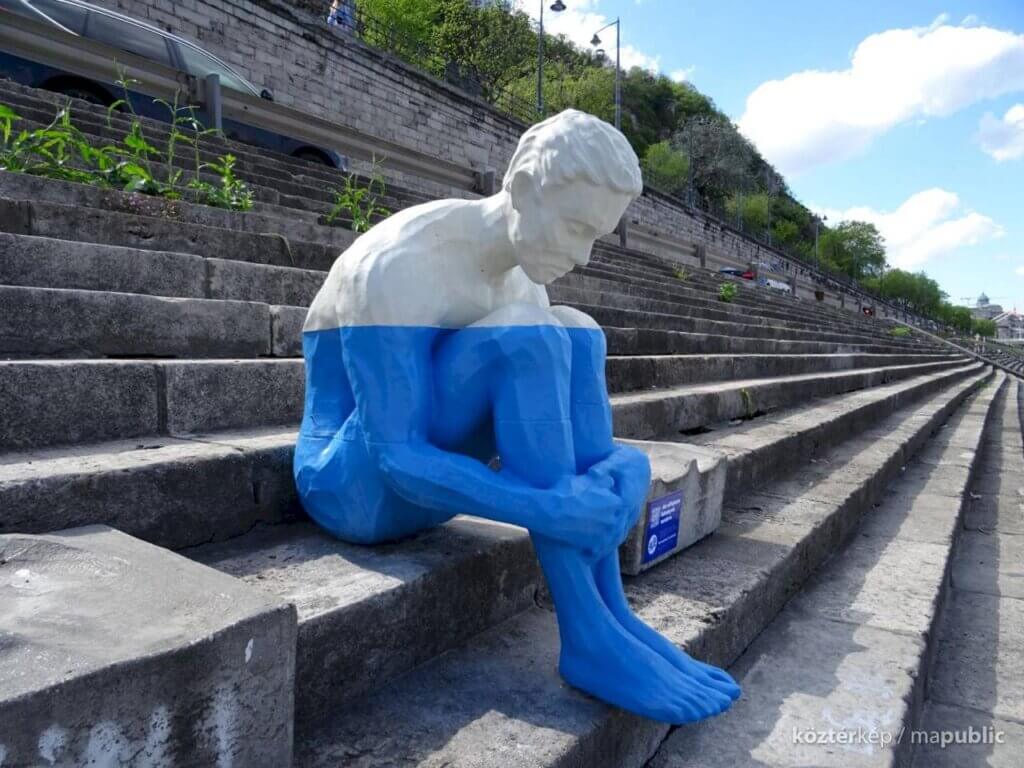
Recently, my attention was drawn to this man on the shores of Danube river. What story does this tell you?
The name of this sculpture is The Statue of Uncried Tears, and it symbolizes a person carrying years of unprocessed emotions.
Last week, in my newsletter on resilience, I wrote that resilience is more like a flexible muscle than a tough bone. Yet many high performers — especially in leadership, finance, consulting, entrepreneurship, and sports — are conditioned to exhibit toughness and invulnerability, suppressing emotions and “pushing through.”
From childhood onward, many of us are taught that emotional suppression is equivalent to emotional control. But suppression is not resilience.
Suppressed emotions do not disappear. Over time, the tension accumulates and causes harm:
- impairs judgment and clarity
- reduces adaptability under stress
- contributes to burnout and emotional numbness
- surfaces unexpectedly through irritability, withdrawal, or overreaction
- affects us physiologically: sleep, digestion, immunity, and cardiovascular health
- puts strain on our relationships and social connections, and our empathy toward ourselves and others
- it even impacts our memory and cognitive performance
Why emotions are essential
Emotions exist for a reason. At birth, they were essential to our survival. They signaled to our caretakers distress, attachment needs, and danger. They helped us bond with those we depended on.
Later, emotions were needed to integrate socially and respond appropriately to our environment.
Emotions also carry information to our body. For example:
- when something matters
- when boundaries are crossed
- when we need rest
- when we need connection
When we suppress emotions entirely, we also suppress access to that information.
How do we substitute for our suppressed emotions? We gravitate toward:
- Avoidance, hyperactivity
- State-altering behaviors
- Rationalizing instead of embracing feelings
- Blaming external factors
If any of this shows up, get curious and check in with yourself.
Does emotional health mean expressing everything impulsively?Of course not.
Emotional maturity is acception of all emotions as necessary, combined with your emotional awareness and regulation.
A few practices that genuinely help to regain emotional regulation:
TO STABILIZE
- Establish a sleep routine
- Exercise (especially lower-intensity movement with breath awareness)
- Engage in activities where you feel fully in control, that are valuable to you, that anchor your attention in the present
TO RECONNECT WITH YOUR EMOTIONS
- Reduce the volume of the inner critic
- Name the emotions — we cannot process what we cannot name. Journal, speak with a trusted confidant, or practice intentional self-talk. Hearing your own voice can be very therapeutic.
- Identify triggers and the underlying unmet need or conflict. Commit to one step to resolve this conflict.
- And lastly: therapy and coaching can be profoundly valuable. Approaches such as CBT help people develop emotional awareness, reappraisal, and healthier regulation patterns — not by eliminating emotion, but by learning how to work with it constructively.
I work with many high performers, and the breakthrough is not about becoming tougher. It is becoming more emotionally integrated without losing ambition, standards, or drive.