
As our careers progress, our personal roles evolve, our ambitions expand, time becomes our scarcest resource. Add to that the constant presence of our phones and social media—quietly but persistently exausting our attention—and we find ourselves increasingly disconnected from ourselves.
Many of us have forgotten what it truly feels like to be alone—without stimulation, without urgency, without the reflex to respond. Silence feels unfamiliar. “Boredom” feels uncomfortable. Yet it is precisely in those spaces that clarity, creativity, and self-awareness emerge.
Relearning how to be with ourselves requires intention. It takes time to unlearn the habit of instant responses—to notifications, to expectations, to the needs of others. It takes discipline to pause before saying yes. And it takes courage to say no.
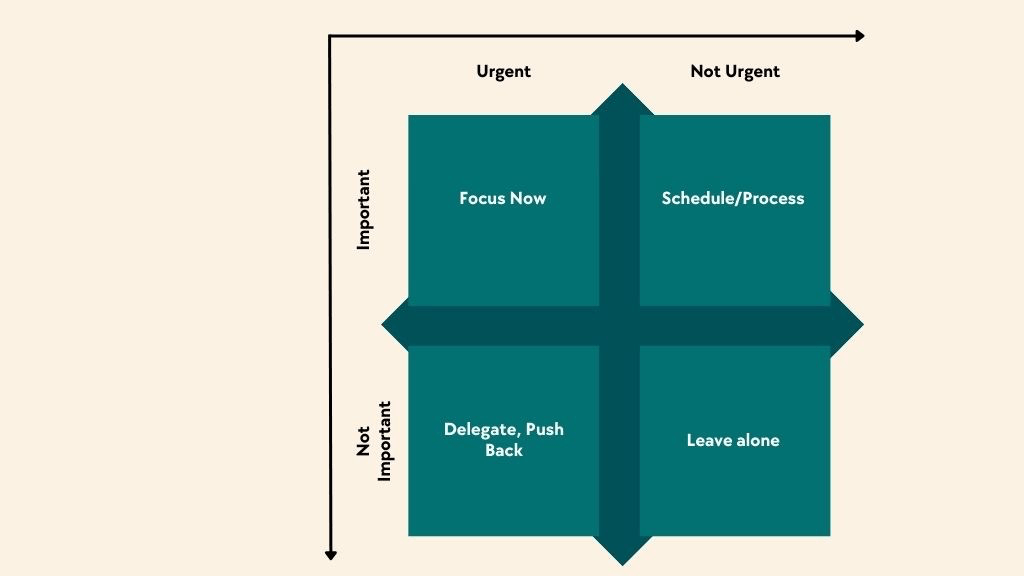
One simple yet powerful tool I often return to is an efficiency matrix—a clear, visual framework that helps structure daily overwhelm. By categorizing what is urgent, important, delegated, or eliminated, we create space to think rather than merely react. It sharpens focus and highlights two essential leadership skills: the ability to say “No” and the willingness to ask for or offer help strategically.
Both are acts of maturity.
With time—and often with age—we begin to value space more than status, clarity more than speed, and depth more than constant activity. However, when operating under sustained pressure, especially with elevated cortisol levels, our perspective narrows. We develop blind spots. We overcommit. We misjudge what truly matters.
This is where reflection—and sometimes coaching—becomes essential.
Coaching provides a structured pause. It helps you decide what belongs in which box. What is genuinely important? What is merely loud? Who and what deserve your energy? And what can you consciously release?
Clarity is not a luxury. It is a leadership competency.
If you find yourself stretched thin, constantly reactive, or unsure where your time truly goes, perhaps it is time to reassess your matrix. I am here to support that process—if and when you are ready.